
Software Development
Websites, ERP and custom inventory systems built around your business.
7SCSC develops websites and business applications around the way your team works. Connect customer inquiries, sales, inventory, projects and internal approvals in a practical system with clear access, useful reporting and room to grow.
- Site focused
planning - Connected
systems - Ongoing
support
The operational challenge
What the system needs to solve.
Spreadsheets, paper records and disconnected applications create duplicate entries and make it difficult to track responsibility. Start with your actual workflow, then build the tools your team needs to manage information consistently.
Functions, workflow & delivery
Software shaped around the way you work.
Explore the functions and design options below. The final components, licenses and integration scope are confirmed against your site requirements.
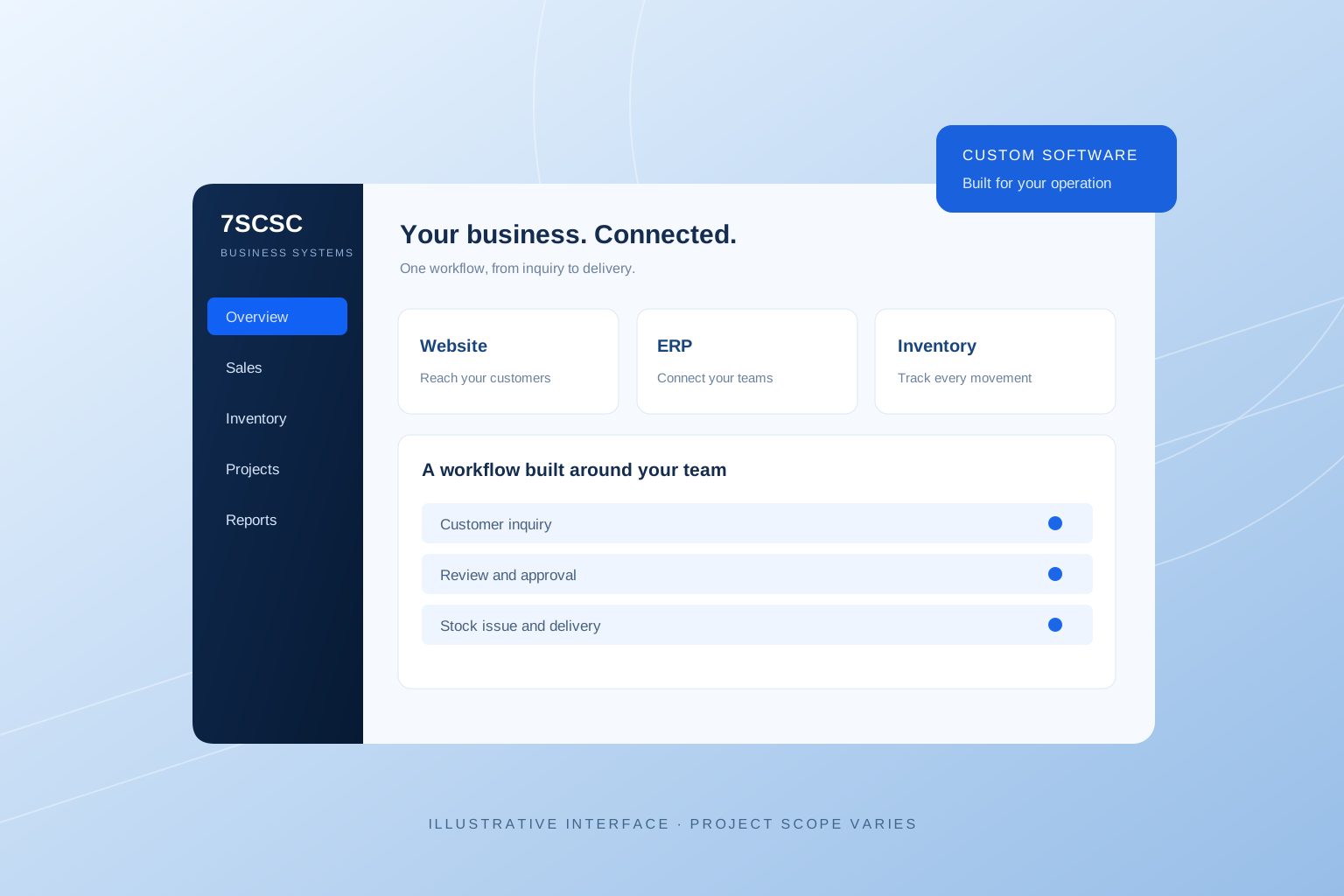
Illustrative concepts of software workflows, not client project photographs.

Company websites
Present services clearly on desktop and mobile, capture inquiries and give authorized staff a way to maintain content.

Connected ERP modules
Keep customers, products and projects consistent across agreed sales, procurement, operations and finance workflows.

Inventory and warehouse control
Define stock movements, units, locations and serial tracking. Review opening balances and control adjustments with an audit trail.

Approvals and reporting
Give each role the right access, route requests to the responsible reviewer and make reports traceable to saved records.

Data migration and integration
Map existing spreadsheets and supported APIs. Validate sample records, reconcile totals and agree how errors and duplicates are handled.

Deployment and handover
Test real workflows with your team, document responsibilities and plan backups, recovery and ongoing maintenance.
What makes up the system
- Responsive website or business application
- Shared database with role-based access
- Agreed modules, forms and approval workflows
- Reports, exports and activity history
- Hosting, backups and supported integration interfaces
How the project works
- 01Review users, existing files and business procedures
- 02Agree modules, acceptance criteria and a working prototype
- 03Build iteratively and validate representative data
- 04Run user acceptance testing and train the team
- 05Deploy the agreed scope with a maintenance and handover plan
What we confirm before implementation
- Required users, roles, approvals and access boundaries
- Module priorities and existing data quality
- Stock units, locations and transaction rules
- Third-party API access and licensing
- Hosting, backup and recovery responsibilities
- Acceptance tests, ownership, training and support scope
Share your current workflow, existing tools and priorities so the proposal can define modules, integrations and acceptance criteria.
In practice
Where it fits
Plan software development around your environment, equipment and the people who use it.
- Company websites and customer inquiry portals
- Growing businesses managing sales, purchasing and projects
- Warehouses and distributors tracking stock across locations
- Service teams coordinating field work and internal approvals
Connected systems
for real impact
How it connects
- 01Understand your workflow
- 02Agree scope and prototype
- 03Build and connect modules
- 04Test with your team
- 05Deploy, train and support
Technology shaped around your operation
Project preparation
Prepare your software project brief
Choose the first workflow to improve, then define the users, records and decisions it involves. Existing spreadsheets and sample reports help make the scope concrete.
Show the current workflow
Walk through a real task using example records with sensitive details removed. Explain what starts the task and what counts as finished.
- Required website or business modules and first-release priorities
- User roles, approval steps and access boundaries
- Forms, reports and exports the team needs
Plan data and integrations
List existing files and services before agreeing an import or connection. Review sample records and reconcile results before accepting a migration.
- Source spreadsheets, field mappings and duplicate-handling rules
- Opening records or balances and sample validation checks
- Required external interfaces, access and third-party fees
Agree acceptance and ownership
Define a practical test for each included workflow. Hosting, support and ownership arrangements belong in the proposal before development starts.
- Prototype review, user acceptance tests and training
- Hosting, backups, recovery and ongoing responsibilities
- Source-code ownership, handover and change-request terms
Questions about Software Development
Can we start with a website or a single module?
Yes. Start with a defined priority such as a company website, inventory tracking or sales approvals. Later phases can extend shared records and workflows as requirements are confirmed.
Can existing Excel data be transferred?
Existing files can be reviewed for import. Field mapping, duplicate handling, opening balances and sample validation are agreed before any migration is accepted.
Can the system run on our own server?
Hosting can be planned for a suitable company server or cloud environment. Access, backups, recovery, updates and ongoing responsibilities are defined during discovery.
Are payroll, accounting and third-party integrations included?
Only the modules and integrations listed in the agreed scope are included. Payroll and accounting rules require separate validation; external services depend on interface access, licensing and vendor limitations.
What happens after deployment?
The proposal defines training, handover, support hours, maintenance and change requests. Source-code ownership, hosting and third-party fees are agreed before development starts.



Project requirements
Discuss Software Development requirements
Describe the workflow, current tools and first release you want to build.
Include in your inquiry
- Required users, roles, approvals and access boundaries
- Module priorities and existing data quality
- Stock units, locations and transaction rules
- Third-party API access and licensing
- Hosting, backup and recovery responsibilities
- Acceptance tests, ownership, training and support scope